
AI for Job Search
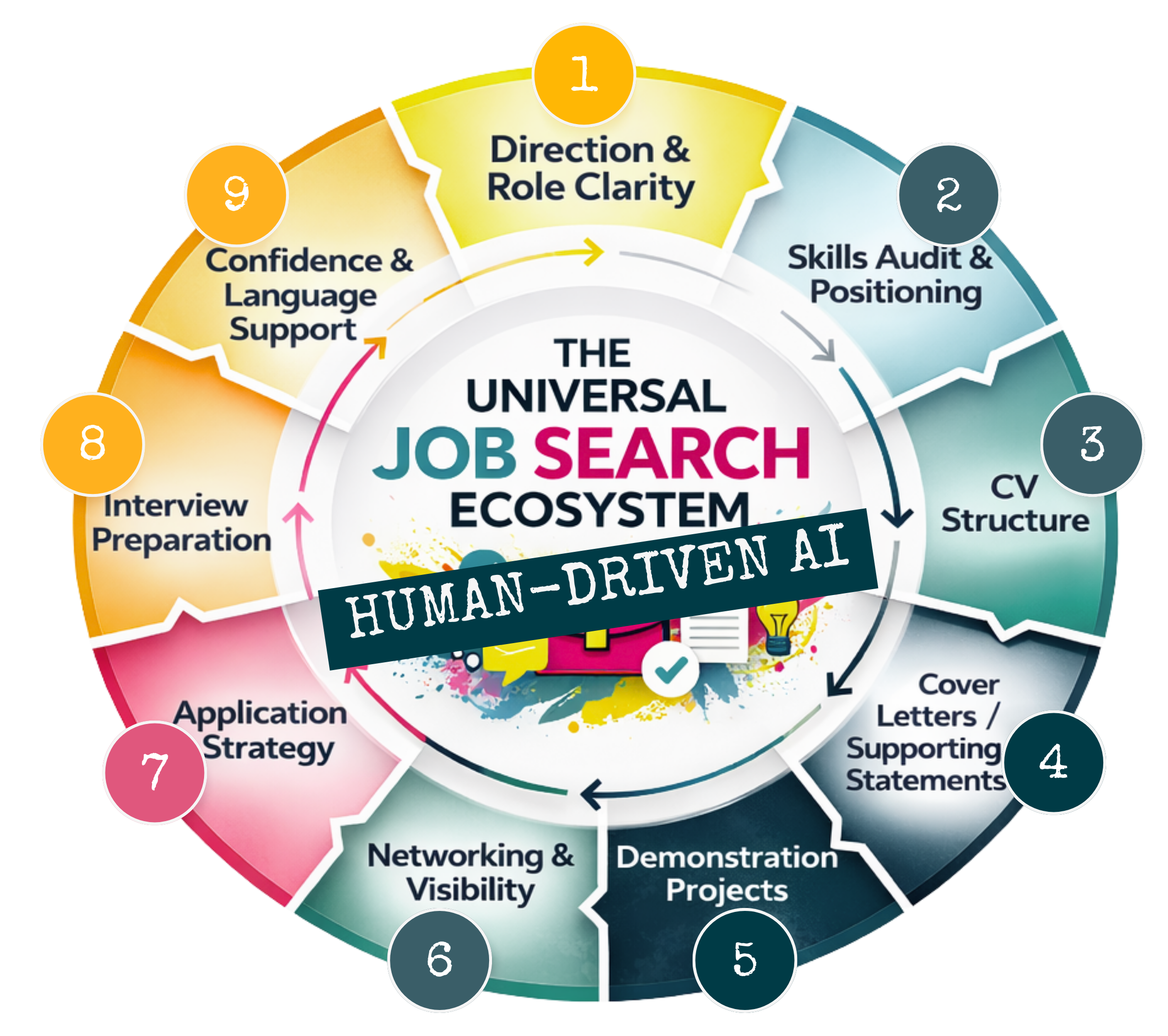
Follow this Job Search Journey for clearer, stronger job applications. Start at number one, move forward step-by-step. Each stage gives you practical guidance, templates and prompts to move ahead confidently.
All of our prompts follow the Human-Driven AI 4Ds framework: Discover what you have and where you stand, Define what matters and what you are aiming for, Develop stronger structure and language, and Deliver something ready to refine. The final output must always be human. AI helps you think, structure and sharpen your ideas, but the voice, judgement and lived experience are yours.
Direction and Role Clarity
-
Copy and paste this into AI:
I want help clarifying the direction of my job search.
Here is my current situation:
[Explain where you are right now. For example: working part-time, unemployed, changing career, returning after a break.]Here is my past experience:
[List 3–5 main roles, responsibilities or life experiences that shaped your skills.]Here are tasks I naturally enjoy:
[Describe what you like doing, even if it wasn’t your official job title.]Here is the type of work environment I would prefer:
[Remote, structured office, flexible hours, working with people, independent work, community setting, etc.]Using the Human-Driven AI approach:
Discover: Help me identify patterns in my experience and interests.
Define: Suggest 3 realistic job directions that could suit me.
Develop: Explain why each direction makes sense based on what I’ve shared.
Deliver: Suggest one small, practical next step for each direction.Then, act as an experienced recruitment adviser and ask me at least 5 follow-up questions that would help clarify my direction further. Do not assume. Ask thoughtful, specific questions to narrow my focus.
Wait for my answers before giving final recommendations.
-
Copy and paste this into AI:
I want to understand how to position myself more clearly in the job market.
Here is a summary of my experience:
[Write freely. Include paid work, unpaid work, education, caring roles, community work. It does not need to be polished.]Using the Human-Driven AI 4Ds:
Discover: Extract my key strengths in clear, simple language.
Define: Group these strengths into 3 skill themes.
Develop: Suggest 2–3 types of roles where these strengths would be valuable.
Deliver: Draft a short positioning statement I could use when someone asks what I’m looking for.After that, act as a recruitment specialist and challenge me. Ask me questions that test whether my positioning is clear, realistic and focused. Ask about level, salary expectations, flexibility, and industry preferences.
Do not finalise anything until I respond to your questions.
-
Copy and paste this into AI:
I am considering applying for this role:
[Paste the job title and key responsibilities.]
Here is my background:
[Brief summary of your experience and skills.]Using the 4Ds:
Discover: Compare my experience to the role requirements.
Define: Identify where I am a strong match and where there are gaps.
Develop: Suggest realistic ways I could strengthen my profile if I apply.
Deliver: Give an honest view on whether this role fits my current level.Then act as a hiring manager and ask me probing questions you would ask in an interview for this role. Help me see whether I am genuinely ready or whether I need to refine my direction.
Pause after your questions and wait for my responses.
Skills Audit and Position
-
Copy and paste this into AI:
I want to do a proper skills audit.
Here is a summary of my work and life experience:
[Write freely. Include paid work, volunteering, caring responsibilities, education, side projects, community roles.]Here are tasks I’ve done repeatedly:
[List specific tasks. For example: managing schedules, supporting customers, handling complaints, analysing data, organising events.]Using the Human-Driven AI 4Ds:
Discover: Extract all the transferable skills from what I’ve shared. Use simple, everyday language.
Define: Group these into clear skill categories, such as communication, organisation, technical ability, leadership, problem-solving.
Develop: Explain where these skills are strongest and how they show up in real situations.
Deliver: Create a clear summary of my top 8–10 skills that I could confidently use in a CV or LinkedIn profile.Then act as an experienced recruiter and ask me questions to test whether I have evidence for each skill. Ask for specific examples. Challenge anything that sounds vague.
Wait for my answers before refining the final skills list.
-
Copy and paste this into AI:
I want to position my skills for this job direction:
[Write the job title or type of role.]Here are my key skills:
[Paste the skills summary from Prompt 1.]Here is what I believe this role requires:
[Write what you think employers are looking for.]Using the 4Ds:
Discover: Compare my skills to what this role typically demands.
Define: Identify 5–7 skills I should emphasise most strongly.
Develop: Suggest how to describe these skills in a way that sounds confident and clear.
Deliver: Draft a short “professional profile” paragraph tailored to this direction.Then act as a hiring manager in this field and ask me critical questions about gaps, level of experience, and credibility. Ask where I might be overstating or underselling myself.
Pause and wait for my response before improving the positioning statement.
-
Copy and paste this into AI:
I want to understand where my skill gaps are.
Target role:
[Write the job title.]Here is my current skill set:
[Paste your skills summary.]Using the Human-Driven AI 4Ds:
Discover: Identify the skills or experiences I may be missing for this role.
Define: Separate gaps into three groups: essential, useful, and optional.
Develop: Suggest practical ways I could build or demonstrate the essential gaps within the next 3–6 months.
Deliver: Create a simple action plan with small, realistic steps I could take.Then act as a recruitment adviser and ask me questions about time, confidence, resources, and constraints. Help me adjust this plan so it fits my real life, not an ideal version of it.
Wait for my answers before finalising the action plan.
CV Structure
-
Copy and paste into AI:
I am preparing a CV for this role or sector:
[Write the job title or type of work.]Here is a short summary of my background:
[Brief overview of your experience.]Using the Human-Driven AI 4Ds:
Discover: Identify what employers in this field usually prioritise in a CV.
Define: Suggest a clear structure I should use (for example: profile, key skills, work experience, education).
Develop: Explain what type of information should sit under each section.
Deliver: Provide a simple outline template with headings only, not full written content.Do not write my CV for me. Instead, guide me on what I should include and what I should avoid.
Then ask me 5 specific questions that will help me strengthen the content before I start writing.
-
Copy and paste into AI:
Here is a section of my CV that I have written myself:
[Paste your own wording.]
Using the 4Ds:
Discover: Identify where my wording is unclear, repetitive or too general.
Define: Highlight sentences that could be more specific.
Develop: Suggest ways I could improve clarity or add evidence.
Deliver: Provide examples of stronger phrasing, but leave space for me to rewrite in my own words.Do not rewrite everything. Help me improve what I have written while keeping my voice.
Then act as a recruiter and ask me what measurable results or specific examples I could add to make this stronger.
Wait for my answers before suggesting improvements.
-
Copy and paste into AI:
Here is a job description:
[Paste job description.]
Here is my CV:
[Paste your CV.]
Using the Human-Driven AI approach:
Discover: Identify the key requirements and keywords in the job description.
Define: Compare them to my CV and highlight where I match and where I am weaker.
Develop: Suggest which parts of my CV I should adjust to better reflect this role.
Deliver: Provide a short checklist of changes I should make myself.Do not fully rewrite my CV. Instead, guide me on how to improve alignment while keeping it honest and accurate.
Then ask me questions about whether I can genuinely demonstrate each required skill before I submit my application.
Cover Letters
-
Copy and paste into AI:
I am applying for this role:
Job title:
[Insert job title]Job description:
[Paste full job description]Here is my CV:
[Paste your CV]Using the Human-Driven AI 4Ds:
Discover: Analyse the job description and identify the main priorities and repeated themes. Then ask me questions to clarify why I genuinely want this role, what attracts me to it, and how it fits my longer-term goals.
Define: Help me identify which parts of my CV are most relevant to these priorities.
Develop: Guide me in connecting my motivation with my experience in a realistic and honest way.
Deliver: Provide a simple cover letter structure outline with headings only. Do not write the full letter.
Ask me at least 5 thoughtful follow-up questions before finalising the structure. Wait for my responses.
Do not copy phrases directly from the job description. Help me reflect the employer’s language in my own words.
-
Copy and paste into AI:
Here is the job description:
[Paste full job description]
Here is my CV:
[Paste CV]
Using the 4Ds:
Discover: Identify the 3–5 most important requirements and keywords in the job description.
Define: Compare those requirements to my CV and highlight where I clearly match and where I need stronger evidence.
Develop: Suggest specific examples from my experience that I should expand on in my cover letter.
Deliver: Create a practical checklist of points my cover letter must address.
Do not write the cover letter. Help me understand what needs to be emphasised and why.
Then ask me follow-up questions to check whether I can genuinely demonstrate each key requirement.
Pause and wait for my responses before refining the checklist.
-
Copy and paste into AI:
Here is my draft cover letter:
[Paste your draft]
Here is the job description:
[Paste full job description]
Here is my CV:
[Paste CV]
Using the Human-Driven AI approach:
Discover: Identify where my draft clearly aligns with the job description and where it does not.
Define: Highlight any vague, generic or repetitive language.
Develop: Suggest ways I can improve clarity, strengthen evidence and better reflect the employer’s language while keeping my own voice.
Deliver: Provide a list of specific improvements I should make myself before submitting.
Do not rewrite the entire letter. Focus on guidance and improvement, not replacement.
Then act as a hiring manager and give me honest feedback about whether my motivation feels genuine and whether my examples are convincing.
Pause and wait for my responses.
Demonstration Projects
-
Copy and paste into AI:
I am targeting this role:
Job title:
[Insert job title]Job description:
[Paste full job description]Here is my current experience:
[Brief summary of your skills and background]
Using the Human-Driven AI 4Ds:
Discover: Identify the most important skills this role requires.
Define: Suggest 2–3 simple demonstration projects I could realistically create to show these skills.
Develop: Explain what each project should include and what outcome it should demonstrate.
Deliver: Help me choose one project that fits my current ability level and time constraints.
Do not suggest unrealistic or overly complex projects. Focus on something I can complete within 1–2 weeks.
Then ask me questions about my time, confidence and tools available before finalising the recommendation.
Pause and wait for my responses.
-
Copy and paste into AI:
I have chosen this demonstration project:
[Describe the project idea]
Target role:
[Insert job title]
Using the 4Ds:
Discover: Clarify what skill or competency this project should prove.
Define: Create a simple structure for this project (for example: introduction, task, solution, result).
Develop: Suggest what evidence or outcomes I should include to make it credible.
Deliver: Provide a checklist I can follow while building this project.
Do not create the project for me. Help me structure it properly.
Then ask me questions to test whether the project genuinely reflects the skills required for the job.
Pause and wait for my responses.
-
Copy and paste into AI:
Here is my completed demonstration project:
[Describe what you built or paste relevant content]
Target role:
[Insert job title]
Using the Human-Driven AI approach:
Discover: Identify which skills this project demonstrates.
Define: Help me summarise the purpose of this project clearly.
Develop: Suggest how I can describe this project on my CV, LinkedIn profile or in an interview.
Deliver: Provide 3 short ways I could explain this project confidently in an application or interview.
Do not exaggerate or invent results. Keep everything aligned with what I have actually done.
Then act as a hiring manager and ask me follow-up questions about this project as if you were interviewing me.
Pause and wait for my responses.
Networking and Visibility
-
Copy and paste into AI:
I am targeting this role or sector:
[Insert job title or industry.]
Here is my current situation:
[Employed, unemployed, career change, returning after a break.]
Here is my confidence level with networking:
[Low, medium, high – explain briefly.]
Using the Human-Driven AI 4Ds:
Discover: Identify realistic visibility channels for my sector. Include both digital (for example LinkedIn, online groups) and in-person options (local events, job fairs, professional meetups, volunteering).
Define: Help me choose 3–5 visibility actions that suit my personality and time availability.
Develop: Create a simple 4-week visibility plan with small, consistent actions.
Deliver: Provide a clear weekly checklist I can follow.
Do not suggest unrealistic or expensive strategies. Keep it practical.
Then ask me questions about barriers (confidence, childcare, transport, time) and adjust the plan to fit my reality.
Pause and wait for my responses.
-
Copy and paste into AI:
Target role or sector:
[Insert role.]
Here is my background:
[Short summary of experience.]
Using the 4Ds:
Discover: Identify the most relevant parts of my background for this role.
Define: Help me create a short, clear introduction I could use when meeting someone at an event or online.
Develop: Suggest 2–3 variations depending on the situation (formal event, informal conversation, online message).
Deliver: Provide a structure I can personalise in my own words.
Do not create a scripted speech. Help me develop something natural and authentic.
Then ask me follow-up questions to refine clarity and confidence.
Pause and wait for my responses.
-
Copy and paste into AI:
I am targeting this role or sector:
[Insert job title.]
Here is my current LinkedIn profile summary:
[Paste text.]
Using the Human-Driven AI approach:
Discover: Identify whether my profile clearly communicates what I am looking for.
Define: Highlight changes I should make to improve clarity and positioning.
Develop: Suggest 3 types of simple LinkedIn activity that would increase my visibility (for example commenting, sharing insights, posting reflections).
Deliver: Create a simple, realistic 4-week LinkedIn engagement plan.
Do not suggest complex content strategies. Keep this manageable.
Then ask me questions about what might stop me from being consistent and help me adjust the plan.
Pause and wait for my responses.
Application Strategy
-
Copy and paste into AI:
Help me stop applying randomly and instead build a clear, realistic application strategy.
Prompt template:
I am currently looking for roles in:
[Write the job titles or type of roles you are targeting.]My experience includes:
[Summarise your key experience in a few sentences.]The industries or sectors I am most interested in are:
[List them.]My current situation is:
[Are you employed? Unemployed? Career changing? Returning to work?]Using the Human-Driven AI 4Ds framework:
Discover: Help me assess whether my target roles are realistic based on my experience.
Define: Help me narrow my focus to 1–3 role types instead of applying to everything.
Develop: Suggest a weekly application rhythm (how many roles, where to search, how to track).
Deliver: Help me create a simple tracking structure I can use to monitor progress.Then act as a recruitment strategist and ask me focused follow-up questions to strengthen my application strategy and avoid wasted effort.
-
Copy and paste into AI:
Help me decide whether a role is worth applying for and how to approach it properly.
Prompt template:
Here is the job title:
[Paste job title]Here is the full job description:
[Copy and paste the full job description.]Here is a short summary of my relevant experience:
[Paste a tailored summary from your CV.]Using the Human-Driven AI 4Ds framework:
Discover: Identify what the employer truly cares about in this role.
Define: Highlight where I am a strong match and where I may need to position myself carefully.
Develop: Suggest how I should adapt my CV and cover letter for this specific role.
Deliver: Help me decide whether to apply and what angle to lead with.Do not rewrite my CV. Instead, guide me on what to emphasise and what to leave out.
Then ask me questions that will help sharpen my positioning for this role before I apply.
-
Copy and paste into AI:
Help me reflect on what is working and what is not.
Prompt template:
So far, I have applied for:
[Number of roles and type of roles.]The response rate has been:
[Interviews? Rejections? No replies?]Here are two or three example job titles I applied for:
[List them.]Using the Human-Driven AI 4Ds framework:
Discover: Help me analyse patterns in the types of roles I am applying for.
Define: Identify whether my positioning may be too broad or unclear.
Develop: Suggest adjustments in role selection, tailoring, or networking before applying.
Deliver: Help me create a clearer strategy for the next 30 days.Then act as a hiring manager and ask me honest, constructive questions about my approach so I can improve it.
Interview Preparation
-
Help me prepare properly for a real interview, based on the role and my experience.
Prompt template:
The job title is:
[Paste job title]Here is the job description:
[Copy and paste the full job description.]Here is a short summary of my experience:
[Paste a tailored summary from your CV.]Using the Human-Driven AI 4Ds framework:
Discover: Identify the key themes and competencies this interview is likely to focus on.
Define: Help me clarify the three strongest strengths I should lead with.
Develop: Suggest likely interview questions based on the job description.
Deliver: Help me structure strong answer outlines using my real experience.Do not write full scripted answers for me. Instead, give me bullet point structures so I can speak naturally in my own words.
Then act as the interviewer and ask me 3–5 follow-up questions so I can practise responding.
-
Help me turn vague answers into clear, evidence-based responses.
Prompt template:
Here is one interview question I struggle with:
[Paste the question.]Here is how I would currently answer it:
[Write your honest, rough answer.]Using the Human-Driven AI 4Ds framework:
Discover: Identify what the interviewer is really assessing with this question.
Define: Highlight what is missing or unclear in my current answer.
Develop: Help me structure my response using a clear framework (for example situation, action, result).
Deliver: Suggest how I can make the answer more specific and confident while keeping it authentic.Do not rewrite my answer completely. Instead, guide me on how to strengthen it.
Then ask me follow-up questions that would help me deepen my example.
-
Copy and paste into AI:
Help me prepare mentally and practically for the interview environment.
Prompt template:
The type of interview is:
[Online, in person, panel, assessment centre.]What makes me nervous is:
[Be honest here.]My biggest concern is:
[For example: technical questions, confidence, gaps in CV.]Using the Human-Driven AI 4Ds framework:
Discover: Help me understand what might be causing my anxiety.
Define: Clarify what I can control and what I cannot control.
Develop: Suggest practical preparation steps for the 48 hours before the interview.
Deliver: Help me create a short personal preparation plan for the day itself.Then act as an experienced hiring manager and give me realistic reassurance alongside practical advice, and ask me questions that would help me feel more prepared.
Confidence & Language Support
-
Copy and Paste this into AI:
Help me explain my experience in a clear and confident way.
Prompt template:
Here is how I usually describe my experience:
[Write it exactly as you would say it, even if it feels messy.]Here is the type of role I am applying for:
[Paste job title or short description.]Using the Human-Driven AI 4Ds framework:
Discover: Identify what is unclear, weak, or too vague in how I describe myself.
Define: Help me clarify my core strengths and what I want to be known for.
Develop: Suggest stronger, clearer ways to phrase my experience while keeping it authentic to how I speak.
Deliver: Help me create a short 30–45 second professional introduction I can practise in my own words.Do not write something that sounds corporate or artificial. Keep it grounded and natural.
Then ask me follow-up questions that would help refine this introduction further.
-
Copy and Paste this into AI:
Help me strengthen how I write and speak in professional situations.
Prompt template:
Here is a paragraph I wrote (email, cover letter extract, LinkedIn post, or application answer):
[Paste text.]Using the Human-Driven AI 4Ds framework:
Discover: Identify where the language feels unclear, repetitive, or under-confident.
Define: Highlight where I am underselling myself or avoiding direct statements.
Develop: Suggest clearer, stronger wording while keeping my tone and personality.
Deliver: Provide a revised version that still sounds like a real person, not a generic template.Then explain what changed and why, so I learn from it.
-
Copy and paste into AI:
Help me prepare to speak in interviews, meetings, or networking events.
Prompt template:
The situation I am preparing for is:
[Interview, networking event, presentation, etc.]What makes me nervous is:
[Be specific.]What I want to communicate is:
[Key message.]Using the Human-Driven AI 4Ds framework:
Discover: Help me identify what is behind my hesitation.
Define: Clarify the one or two messages I need to communicate clearly.
Develop: Suggest a simple structure I can follow when speaking.
Deliver: Help me rehearse by asking me realistic questions so I can practise answering in my own words.Do not script everything for me. Instead, guide me and challenge me so I can build confidence through practice.
Choose the Right CV Strategy for Your Story
The way your CV is structured shapes how your experience is understood.
Before writing or editing, take a few minutes to decide what your story needs to emphasise and how it should be read.
CV Strategy Assessment
-
Use this first to understand the shape of your career before choosing a CV structure.
Step 1: Get your information ready
Open your current CV and choose one of these options:Copy and paste the full text of your CV into the chat, or
If you don’t have a CV yet, write a rough list of your roles with dates, job titles, employers, and a few lines on what you did in each role.
Step 2: Copy this prompt into AI
I want to choose the right CV structure before writing anything.
Act as an experienced recruiter and career strategist.Analyse the information I paste below and describe:
The overall shape of my career so far
The strengths and themes that show up repeatedly
Any transitions, pivots, gaps, or short roles that a recruiter will notice
The likely questions a recruiter might have when scanning my timeline
Keep it clear and specific.
Do not write my CV yet.Step 3: Paste your CV (or your work history) underneath the prompt
Then press send. -
Now use AI to compare your experience to the role you want next.
Step 1: Get the role details ready
Choose one:Copy and paste the job description into the chat, or
If you don’t have a job advert, write the job title, sector, and the main responsibilities and skills you keep seeing in similar roles.
Step 2: Copy this prompt into AI
Here is the role I want to apply for:
[Paste job description or role summary]
Based on the career history you analysed earlier, compare me to this role and explain:
Where I align strongly
Where I partially align
Where a recruiter might hesitate or feel uncertain
What my CV needs to emphasise more clearly for this role
Focus on positioning and clarity.
Do not write my CV yet.Step 3: Press send
-
Now AI reviews the four CV structures and recommends the best one for you.
Step 1: Copy this prompt into AI
Using my career history and the target role, evaluate these CV structures:
– Chronological
– Achievement-focused
– Skills-based
– HybridFor each one, explain:
What advantage it would give me
What risk it could create
How a recruiter is likely to read it
Then recommend the strongest strategic option for me and explain why.
Do not draft the CV yet.
Step 2: Press send
Step 3: Read the recommendation carefully and keep it for the next step. -
Confirm My Choice Before Writing (Deliver)
This final step helps you sanity-check the decision so you don’t blindly follow AI.
Step 1: Copy this prompt into AI
Before I commit to this CV structure, help me sense-check it.
What would likely happen if I used a different CV structure than the one you recommended?
What trade-offs would I be making?
What would you look for on a strong CV using the recommended structure?
Keep it practical and specific.
Step 2: Press send
Before you write or edit your CV, decide your strategy.
The structure you choose affects how your experience is interpreted.
This section guides you through a short assessment using the Human-Driven AI 4Ds framework so you can choose deliberately rather than guess.
Take five to ten minutes to complete the steps in order. Once you’ve confirmed your structure, scroll down to the CV Builder section.
CV Builder
AI can help you draft and refine, but your CV should still sound like you.
Recruiters are reading many applications that feel identical. The final version must reflect your judgement, your voice, and your real experience.
Chronological CV Builder
(You selected this structure in your CV Strategy Assessment.)
-
Start with your most recent role.
Write this yourself first:
Job title
Organisation name
Dates (month and year)
One short sentence explaining what the role was about
Do this for each role before using AI.
Now open AI and paste:
I am building a chronological CV.
Using the role below, help me write 3–5 bullet points that clearly explain what I was responsible for and what contribution I made.Keep the language simple and professional.
Do not exaggerate or invent impact.[Paste one role]
Read the response carefully.
Edit it so it sounds like you.You decide the final wording.
-
A chronological CV still needs to show contribution, not just tasks.
Look at each role and ask yourself:
What changed because I was there?
What did I improve, support, organise, deliver, or manage?
What responsibility did I hold?
Now paste this into AI:
Help me strengthen these bullet points so they are clearer about my contribution.
If possible, suggest where I could add simple detail such as team size, volume of work, or scale of responsibility.
Do not make claims that are unrealistic.
[Paste bullet points]
Again, you are in charge. Remove anything that feels inflated.
-
You already defined your direction in the Strategy Assessment.
Now write 3–4 lines yourself:
Your main area of experience
Years of experience
Type of role you are targeting
One or two key strengths
Once you’ve written it, paste it into AI:
Help me refine this summary so it sounds clear and confident.
Keep it grounded and professional.
Do not make it dramatic.[Paste draft]
Edit the output. Keep your voice.
-
Now copy your full CV into AI and say:
Read this as a recruiter reviewing applications quickly.
Tell me:
What stands out clearly
What feels repetitive or unclear
Where I could tighten the language
Do not rewrite it for me.
Just give structured feedback.You make the final edits.
Achievement-Focused CV Builder
(You selected this structure in your CV Strategy Assessment.)
-
Open your CV and look at one role at a time.
Before using AI, answer these questions yourself:
What was I brought in to handle?
What problems did I deal with?
What improved while I was there?
What responsibility did I carry?
What would my manager say I did well?
Write rough notes in plain language.
Now open AI and paste:
I am building an achievement-focused CV.
Using the role below, help me turn my notes into 3–5 bullet points that clearly show my contribution and impact.
Keep the language realistic.
Do not exaggerate or invent results.[Paste one role + your rough notes]
Read the output.
Edit it so it sounds like you. -
Many people think “achievement” means dramatic numbers. It doesn’t.
It can be:
Size of team supported
Number of clients handled
Volume of work
Type of system managed
Timeframe of a project
Look at your bullet points and ask:
Where can I add simple detail to make this clearer?
Now paste into AI:
Help me identify where I could add concrete detail to strengthen these statements.
Suggest realistic ways to make them clearer without exaggerating.
[Paste bullet points]
You decide what is accurate and honest.
-
You already defined your direction earlier.
Now write 3–4 lines yourself answering:
What do I consistently deliver?
What kind of responsibility do I handle?
What environment do I work well in?
Keep it natural.
Then paste into AI:
Help me tighten this summary so it highlights contribution and reliability.
Keep the tone grounded and professional.
[Paste draft]
Edit. Keep your voice.
-
Now paste your full CV into AI and say:
Read this as a recruiter.
Does this CV clearly show contribution and responsibility?
Does anything feel vague?
Does anything sound overstated?
Give feedback only. Do not rewrite it.
You review.
You adjust.
Skills-Based CV Builder
(You selected this structure in your CV Strategy Assessment.)
-
Before using AI, write down:
What do people rely on me for?
What problems do I regularly solve?
What tasks feel natural or strong for me?
What skills match the role I am targeting?
From this list, try to group them into 4–6 broad skill areas.
Examples (only if relevant):
Project coordination
Customer service
Team leadership
Technical systems
Organisation and planning
Do this thinking yourself first.
Now open AI and paste:
I am building a skills-based CV.
Based on the experience below and the role I am targeting, help me organise my strengths into 4–6 clear skill categories.
For each category, write 3–4 bullet points with practical examples.
Keep the language clear and realistic.
Do not invent experience.[Paste your work history + target role]
Read the output carefully.
Adjust the category names if they don’t feel right. -
Now review each skill section.
Ask yourself:
Does this sound specific?
Could I explain this in an interview?
Is there an example behind each statement?
Now paste into AI:
Help me rewrite these skill bullet points so they are clearer and supported by simple examples.
Remove vague phrases and make them practical.
[Paste one skill section at a time]
Again, you are in charge of what stays.
-
Even in a skills-based CV, employers expect context.
Create a simple section that lists:
Job title
Organisation
Dates only
No long descriptions here.
If you want help formatting it, paste into AI:
Create a clean employment history section using job title, organisation and dates only.
Keep it simple and structured.
[Paste your work history]
-
Now paste your full CV into AI and say:
Read this as a recruiter reviewing a skills-based CV.
Does it clearly show capability?
Does it feel credible?
Is anything unclear or unsupported?
Give feedback only. Do not rewrite it.
You review.
You refine.
Hybrid CV Builder
(You selected this structure in your CV Strategy Assessment.)
-
Before using AI, write down:
The 4–5 strengths most relevant to the role you are targeting
What you want the recruiter to understand within the first 10 seconds
Group your strengths into clear headings.
For example:
Client Support
Project Coordination
Operations Management
Communication
Use headings that fit your situation.
Now open AI and paste:
I am building a hybrid CV.
Using my experience and the role I am targeting, help me write a short skills summary with 4–5 headings.
Under each heading, include 2–3 bullet points that show practical evidence.
Keep the language simple and professional.
Do not exaggerate or invent achievements.[Paste your work history + target role]
Read carefully.
Rename headings if they do not feel accurate. -
Now move to your employment history.
Write this yourself first:
Job title
Organisation
Dates
2–4 bullet points explaining responsibility and contribution
Keep it shorter than a fully chronological CV.
Now paste into AI:
Help me refine this employment history section so it is clear and concise.
Focus on responsibility and contribution.
Keep it grounded and realistic.[Paste employment history]
You decide what stays.
-
Now review the top section and the timeline together.
Paste your CV into AI and say:
Review my skills summary and employment history together.
Do they align clearly with the role I am targeting?
Is there repetition?
Is anything important missing?
Give feedback only. Do not rewrite the whole CV.
You review the suggestions.
You adjust manually. -
Paste your full CV into AI and say:
Read this as a recruiter screening quickly.
What do you understand about me within 15 seconds?
Does the structure help clarity?
Where could the language be tightened?
Provide feedback only.
You make the final decisions.